


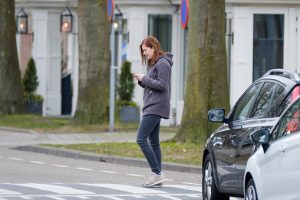
 On the surface, distracted pedestrians appear to be their own worst enemies. We think we know them: the guy who regularly walks against the red light. The woman who steps off the curb and never looks up from her phone. The texting teen who thinks crosswalks are simply a suggestion.
After all, the number of pedestrians and bicyclists killed has spiked. In 2017, nearly 6,000 such Americans died on U.S. roads. The Governors Highway Safety Association (GHSA) has reported that between 2007 and 2016, pedestrian fatalities jumped 27 percent.
But a new study published earlier this year by Northern Arizona University engineering professors reported that 86.5 percent of the people observed "did not exhibit distracted behavior."
The overwhelming majority of the pedestrians did not commit any violations, the survey noted. Just twenty-three percent would cross before the "Walk" sign, or while "Don't Walk" was still flashing.
What the numbers reveal
In the spring and summer of 2017, the professors followed how 3,038 people used crosswalks in New York City and Flagstaff, Arizona. The data was obtained at one signal in New York and three in Flagstaff. Pedestrians were observed with a video camera during the spring and summer of 2017.
A Center for Disease Control (CDC) study cited that 31 percent of U.S. drivers said they'd texted while driving in the past 30 days. Texting while driving, in some circles, is thought to be as dangerous as driving drunk.
"Practitioners must know as much as possible about the behavior of pedestrians and drivers," the study reported. "If they don't know who is distracted while walking (or driving for that matter), they cannot target educational, enforcement, or design strategies, at the people most at risk for these types of behavior."
The Insurance Institute for Highway Safety blames poor headlights for some of the deaths, citing faulty designs on some car models.
Roughly 75 percent of pedestrian fatalities happen at night, according to a spokesperson for the GHSA.
The study arrives a year after Honolulu passed a law giving the police the right to fine people up to $35 for staring at a device while crossing the street. A second violation brings a $75 fine. Then it is a $99 levy.
While 14 percent of distracted walkers at intersections is a statistic lower than expected, it still presents a danger. One proposal in the study suggests preventing drivers from turning right at red lights, and better lighting systems at crosswalks, allowing pedestrians a few more seconds of time to cross the street.
Injured? Need help? Contact the Law Offices of Joe Bornstein. Our attorneys know the Maine law and have the experience and expertise to handle even the most complex claims. In over 45 years, the Law Offices of Joe Bornstein has helped more than 25,000 injured or disabled Mainers get the justice they deserve.